
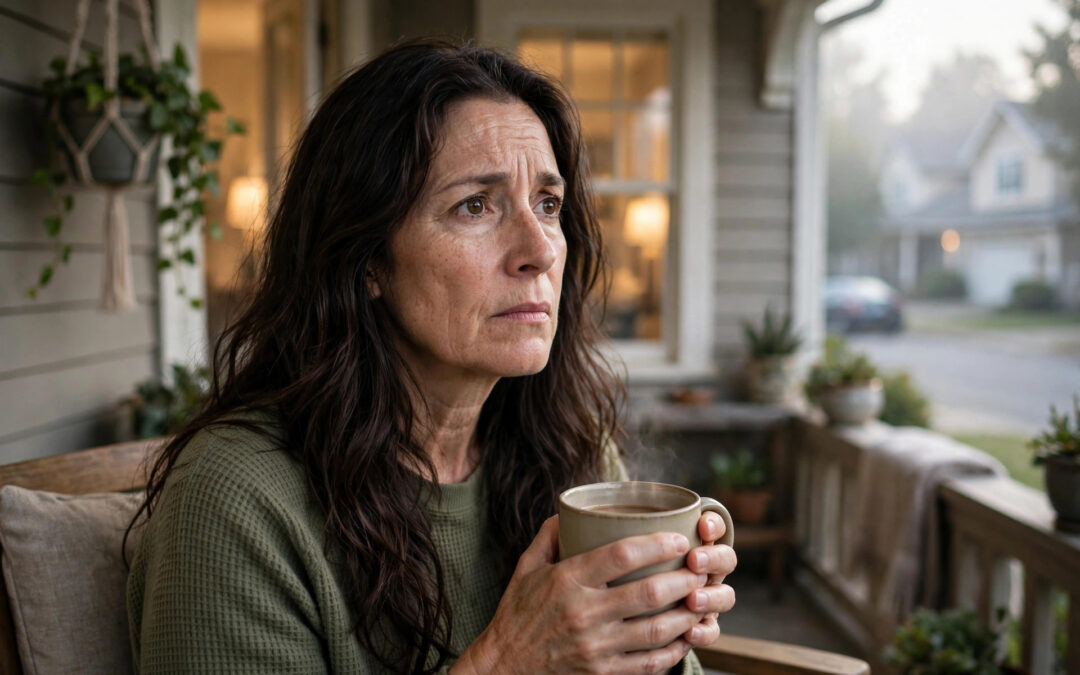
Everything is finally fine. So why won’t your body believe it?
It’s a Saturday morning. The coffee is hot. The bills are paid. The kids are fine, nobody is fighting, and the man sitting across from you is the kind one, the one who stayed, the one you prayed for back when everything was falling apart.
And your chest is tight.
You read his face while he reads the news. You replay the text you sent your sister, checking it for a tone you can’t find. You feel it coming like weather, except the sky is clear and everybody else can see that but you. By lunch you’ve picked a fight about nothing, a tone, a look, dishes in the sink, and now you’re standing in the bathroom hating yourself, asking the question you’ve asked a hundred times:
I finally have the life I prayed for. What is wrong with me that I can’t just be happy in it?
Nothing is wrong with you. I hear this from women whose lives have finally gone quiet, and I want you to hear it plainly: anxiety in the good times is not ingratitude, and it is not a character flaw. It is training. Your life calmed down. Your body never got the news, because the body isn’t listening to your life. It’s listening to your history.
In short
You feel anxious when life is finally good because you learned, young, that calm doesn’t last. In a house where a parent’s mood could turn a good day by dinner, peace was never rest. It was the waiting room before the blow. So your Protective Self built an alarm that treats quiet as a warning, and as an adult it still runs that alarm in a safe house, scanning a kind husband’s face, rehearsing disasters, ruining good nights, because unfamiliar peace registers as danger. The anxiety isn’t about the good life. It’s vigilance and grief surfacing now that there’s finally room to feel them. Healing means grieving what the little girl in you never got to trust, and teaching your body, in small repeated moments, that good is not a trick and it doesn’t have to be paid for with worry.
- In short
- Why peace feels dangerous when you grew up in chaos
- What it looks like when nothing is wrong
- Your protector doesn’t trust the calm
- I know this from the inside
- How to teach your body that good can last
- What to do in the moment, and when to get more support
- Frequently asked questions
- A final truth
Why peace feels dangerous when you grew up in chaos
No little girl is born braced. She learns it, one unpredictable day at a time.
She learned it in a house where she could tell what kind of evening it would be by the sound of the door. Where a good mood at breakfast came with no promise about dinner. Where she got good at reading a room before she could read a book, because reading the room was how she stayed out of trouble she didn’t cause. Nobody hit her with the uncertainty. She just breathed it, every day, until her body decided that watching was the same thing as being safe.
Psychology Today describes the adult version of that childhood in women and men raised by an unstable parent: hypervigilance that lasts well into adulthood, walking on eggshells long after there’s nobody left to tiptoe around, and a feeling of impending doom that shows up even in a good life. And research published in Nature Mental Health has found that unpredictability in childhood, separate from everything else that happened in the house, predicts higher anxiety in adults. It wasn’t only what happened to her. It was that she never knew what would happen next.
So of course a quiet house makes her nervous. Quiet was never the safe part of her childhood. Quiet was the part where you listened hardest.
But here’s what you need to understand. That anxiety did not start with this good life. It started in a house where good never stayed long enough to trust. Your body isn’t reacting to your present. It’s reporting from your past, in present tense.
What it looks like when nothing is wrong
It looks like waiting for the other shoe to drop, in a house where nobody is wearing shoes.
It looks like good news with a countdown attached. He gets the raise and you’re happy for about an hour before you’re rehearsing the layoff. The test comes back clear and by bedtime you’re worrying about the next one. She reads his “ok” text three times, hunting for the coldness underneath it. She checks the bank app right after something good happens, as if joy needs to be audited.
It looks worse on the quiet days, and that’s the part she can’t explain to anyone. Vacation makes it louder. Sundays make it louder. The stillness after the kids are asleep makes it loudest of all, because the noise of a busy life was doing a job for her. It kept everything she’d buried at a distance. In the quiet, what she outran for years finally catches up. Time doesn’t heal. Time reveals. The calm didn’t create the grief. It gave the grief a room quiet enough to be heard in.
She’s often the same woman who holds everything together for everyone else, the one who can’t rest even now that there’s finally less to carry. Rest was never the reward at the end of her childhood days. It was just the part where she waited.
And sometimes it looks like this: a good evening, a kind word, his hand reaching for hers, and she brings up the thing from three months ago. Not because she wants a fight. Because tension is the weather she knows how to stand in, and peace feels like standing in the open with nowhere to hide. A storm she starts is a storm she saw coming. She would rather ruin a good night on purpose than sit in a good one she can’t control.
Then comes the shame. Because she knows how it looks. She knows she’s hurting the people she loves with suspicion they didn’t earn and storms they didn’t start. Her pain explains it. It doesn’t excuse it. Both of those are true, and she has to be able to hold both, or she’ll either drown in guilt or keep calling the pattern “just how I am.”
Your protector doesn’t trust the calm
In the Feel-to-Heal Method, we talk about the Protective Self, the part of you that learned, young, how to keep you safe. Hers has one rule, and she wrote it the day being blindsided hurt worse than the bad thing itself did:
Never be caught off guard again.
So the protector scans. If she imagines the betrayal first, it can’t ambush her. If she rehearses the diagnosis, the layoff, the phone call, then when pain comes she can at least say she knew. In her childhood house, that alarm was honest work. It read real weather. In this house, it goes off at burnt toast. It goes off at a husband whose only crime is being quiet because he’s tired. It goes off at peace itself, because peace is the one thing it was never trained to recognize as safe.
This is the same protector I wrote about in Your Protector Isn’t Protecting You Anymore. The protector is not the enemy, and she is not a liar. She’s a guard still working a post at a house that burned down years ago, faithful to orders written by a little girl.
Here is the sentence I need you to take from this whole post:
That feeling is a memory. It is not a forecast.
You cannot heal what you refuse to feel, and calm is exactly where the unfelt things live. Part of what rises in the quiet is vigilance. But part of it is grief — grief for every good day that little girl couldn’t enjoy because she was too busy watching the door. That grief doesn’t need to be argued with. It needs to be felt, on purpose, by a woman who finally has a life steady enough to feel it in.
I know this from the inside
I spent years becoming someone everyone else could be proud of while struggling to become someone I could feel good about being.
I built the career. I provided. I crossed finish lines. From the outside, my life kept getting better, and I kept waiting for the anxiety to notice and retire. It never did. It just moved into the quieter rooms with me. The success didn’t quiet it, because success was never what it was asking for. Underneath the achievement was a man still braced for the next blow, still refusing to feel what the early years had actually cost him.
What changed me was not a better life. It was finally feeling the one I’d been outrunning, taking responsibility for what my bracing had done to the people closest to me, and letting my body learn, slowly, that I wasn’t in danger anymore.
So when a woman sits across from me and says, “My life is finally good, and I feel worse,” I believe her. I’ve lived in that house. The good life doesn’t heal the girl who never got to trust a good day. Feeling does.
How to teach your body that good can last
First, the fear has to be said out loud, because she believes it like a law: If I relax, that’s when it will happen.
Her vigilance feels like the thing holding the good up, as if worrying were a hand under the shelf. If she sets it down, everything crashes. So hear this plainly: your worry has never held anything up. Not once. It never stopped a single bad thing from happening. It only charged you rent, for years, on disasters that mostly never came.
The body learns the way it learned the first time: by experience, repeated. Not by being argued into peace, but by living through good moments without bracing, over and over, until the alarm starts to believe the house it’s standing in. Concretely:
Name the alarm for what it is.
This is Awareness, the first stage of the Feel-to-Heal Method. In the moment, say it, out loud if you can: “This is the old alarm. This is not news.” You are not broken and you are not psychic. You are a woman whose body learned to predict pain, hearing an echo and calling it a warning.
Stay in the good moment on purpose.
Small reps, not a personality transplant. Finish the coffee before you check anything. Let the good evening run ten minutes past the moment you usually start auditing it. Let him hold your hand without reading his face for weather. Every rep is evidence your body files away: good happened, I enjoyed it, and enjoying it did not ruin it.
Stop pre-grieving.
Why steals. What heals. Every disaster she rehearses, she lives the loss twice — once in her head, in full detail, and then maybe never in real life. She’s been to a hundred funerals that never happened. When the mind runs to what-if, bring it back to what is true in this room, right now. That is not positive thinking. It’s refusing to pay for pain that hasn’t sent a bill. I wrote about that loop in why you can’t think your way out of anxiety, and it runs hardest in a quiet house.
Don’t start the storm to feel in control.
When the urge rises on a good night to bring up the old thing, say the real sentence instead: “Things are good right now, and that scares me.” Said to him, plainly, that sentence is honesty. The ambush is control. Her family deserves the sentence. And the pattern has to be named for what it costs: pain explains the urge, but a hundred manufactured storms still land on real people, and taking responsibility for that is part of her healing, not a detour from it.
Grieve the girl who never got to trust a good day.
Underneath the scanning there is sadness, and it belongs to a child. She never got to come home and simply be glad. She had to check the weather first. Feel that sadness in small honest doses instead of outrunning it with worry. And forgiveness, in this work, means releasing the emotional hold: letting go of the childhood where good was always borrowed, not because it was fine, but because she’s still paying interest on it.
Receive the good without paying for it in worry.
She tries to earn this season by staying braced, as if suffering correctly were the price of keeping it. It isn’t. She doesn’t have to deserve a good life by worrying over it. You can thank God for a good season without waiting for Him to take it back. Peace is not a bill that comes due. For her, learning to receive it — hands open instead of fists up — is the whole work.
What to do in the moment, and when to get more support
In the moment — it’s an ordinary good evening, nothing is wrong, and the tightness is climbing anyway — try this:
Stop. Put both feet on the floor and name what is true in this room, quietly, one fact at a time: “The bills are paid. He is here. The kids are asleep. Nothing is wrong in this room.” Then name the second truth, the one standing right beside it: “And I am scared anyway.” Both can be true at the same time. They usually are. Then ask the fear one question: “What are you protecting me from?” Almost every time, the answer is an old ambush, not a new one. Then do one act of staying: don’t pick up the phone, don’t start the audit, don’t pick the fight. Sit in the good for five more minutes. That is the rep. That is how a body learns.
Frequently asked questions
Why do I feel anxious when things are going well?
Because your body learned, young, that good doesn’t last and that calm is the space before something goes wrong. Peace is unfamiliar to you, and to a Protective Self built in an unpredictable house, unfamiliar registers as unsafe. The anxiety is your past reporting in present tense. It is not a sign that something is secretly wrong with your good life.
Why do I always feel like something bad is about to happen?
That feeling has a name: hypervigilance. As a child, predicting a parent’s mood before it turned was how you protected yourself, so prediction became your resting state. As an adult, the same alarm produces a sense of impending doom in houses where nothing is coming. The feeling is real. What it’s pointing at usually isn’t. It is a memory, not a premonition.
Why can't I relax on vacation or on my days off?
Because stillness removes the noise that was keeping your feelings at a distance. All week, work and schedules and everyone else’s needs hold the buried things down. On a quiet beach or a slow Sunday, there’s nothing left to outrun them with, so grief, fear, and old sadness surface. That’s often why rest feels worse than work for women who grew up braced. The calm isn’t making you anxious. It’s finally letting you hear what was always underneath.
Why do I pick fights when things are good?
Because a storm you start is a storm you saw coming. Tension feels familiar, and familiar can feel safer than a peace you can’t control, so your protector manufactures the weather it knows how to stand in. The honest alternative is harder and shorter: “Things are good right now, and that scares me.” The urge is understandable. Acting on it still costs the people you love, which is why the real sentence matters.
Is feeling anxious when life is good a trauma response?
It can be. When calm itself is the trigger, that usually points back to a childhood where calm wasn’t safe — where good days ended without warning and a little girl learned to watch instead of enjoy. Research on childhood unpredictability backs the connection to adult anxiety. Not every case is trauma, and this isn’t a diagnosis. The tell is the timing: the anxiety shows up because things are good, not in spite of it.
When should I get professional help?
Seek prompt professional or medical help if anxiety is interfering with daily life, if you’re having panic attacks, physical symptoms such as chest pain or trouble breathing, or thoughts of harming yourself. The National Institute of Mental Health’s overview of anxiety disorders is a solid place to understand what you’re dealing with. Coaching supports emotional healing work; it is not therapy and not a replacement for medical care. If the tightness in your chest has become more than a feeling — if it’s become hopeless — please reach out to a therapist, your doctor, or a crisis line today.
A final truth
Your good life is not a trick being played on you, and you are not ungrateful for struggling to trust it.
You learned trust in a house where good came with a countdown, so of course the girl in you still watches the door while everyone else enjoys the room. She is not ruining your life. She is still trying to protect it, with instructions written before she could read.
You don’t need a better life to feel safe in this one. You need to feel what the braced years actually cost you, grieve the good days that little girl never got to simply have, and let your body learn, one quiet morning at a time, that this season is not the setup for a fall.
You’re allowed to live in the good days. Not brace through them. Live in them.
feel-to-heal
Ryan Light is an emotional healing coach, not a therapist. Coaching does not diagnose or treat mental health conditions, and it does not promise guaranteed or immediate outcomes.