
Family Dysfunction Doesn’t End in Childhood: How It Shapes the Adult You Become
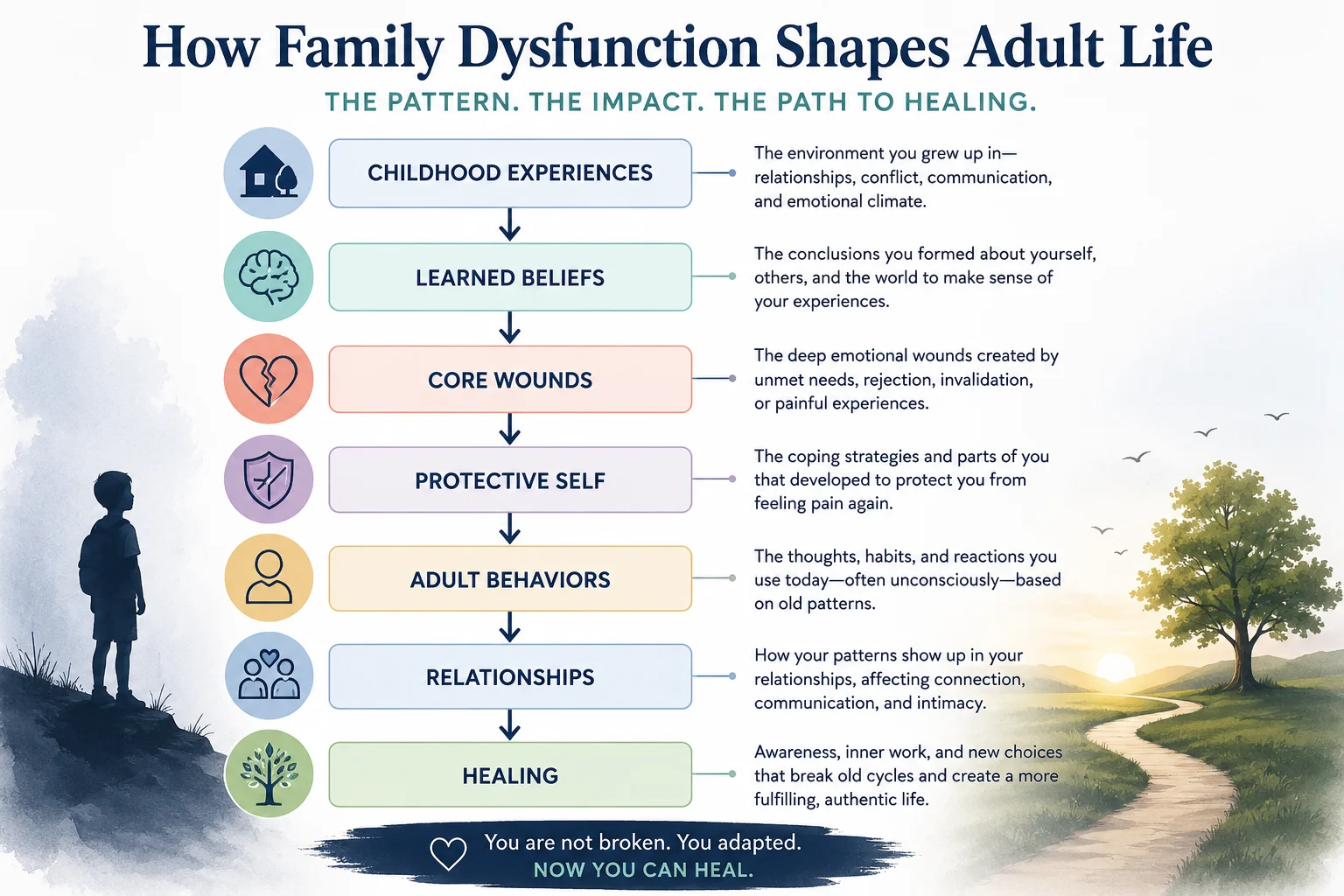 Childhood experiences often shape the beliefs, core wounds, protective behaviors, and relationship patterns that continue into adulthood. Healing begins by understanding-and changing-that pattern.
Quick Summary
Family dysfunction is more than growing up in a home with conflict, addiction, abuse, or poor communication. It’s a pattern of unhealthy emotional dynamics that shapes the beliefs you develop about yourself, relationships, and the world around you. Those beliefs often influence your self-worth, mental health, attachment style, boundaries, and coping behaviors long after childhood ends. In this guide, you’ll learn what family dysfunction is, the signs to look for, its causes, how it creates core wounds and a protective self, and practical steps to begin healing and breaking generational patterns. Whether you experienced emotional neglect, criticism, parentification, or unpredictable family relationships, healing is possible when you understand not just what happened to you-but what you came to believe because of it.
Introduction
Most people think family dysfunction is something you either survived or didn’t. If your parents weren’t abusive, addicted, or constantly fighting, it’s easy to assume your childhood was “normal.” But family dysfunction isn’t defined only by what happened in your home. It’s also defined by what was missing.
- Maybe your feelings were ignored instead of understood.
- Maybe love felt conditional instead of secure.
- Maybe you learned to become the peacemaker because conflict never felt safe.
- Maybe you hid your emotions because no one knew how to respond to them.
- Maybe you became the responsible one long before you were old enough to carry that responsibility.
As children, we don’t choose what we believe about ourselves. We build those beliefs from the experiences we have every day. If you repeatedly felt criticized, rejected, unseen, or emotionally alone, your mind naturally tried to make sense of those experiences. Over time, those conclusions became the lens through which you viewed yourself, other people, and relationships.
That is why family dysfunction doesn’t stay in childhood.
It quietly follows you into adulthood.
It influences who you trust, what you tolerate, how you handle conflict, whether you believe you’re enough, and even the way you love and allow yourself to be loved.
What Great Minds Have Discovered
“Until you make the unconscious conscious, it will direct your life and you will call it fate.” – Carl Jung
The Feel-to-Heal Perspective
One of the greatest gifts you can give yourself is realizing that many of your current struggles didn’t begin with today’s circumstances. They began with yesterday’s experiences.
Your anxiety may not simply be about today.
Your fear of abandonment may not be about your current relationship.
Your people-pleasing may not be about being nice.
They may all be attempts to protect beliefs that were formed years ago.
Healing begins when you stop asking, “What’s wrong with me?” and start asking, “What happened to me, and what did I come to believe because of it?”
Key Insight
You don’t carry your childhood into adulthood-you carry the beliefs your childhood taught you.
Key Takeaways
- Family dysfunction is defined by unhealthy emotional patterns, not by whether a family appears “normal” from the outside.
- Childhood experiences often become lifelong beliefs about yourself, other people, and relationships.
- Core wounds such as abandonment, rejection, shame, inadequacy, emotional neglect, and loneliness can continue influencing your life long after childhood ends.
- Many adult behaviors-including people-pleasing, perfectionism, overthinking, emotional withdrawal, and fear of abandonment-develop as protective strategies rather than personality traits.
- Healing begins when you understand the wound beneath the behavior instead of trying to eliminate the behavior itself.
- You cannot change the family you grew up in, but you can change the beliefs and patterns that continue to shape your life.
What Is Family Dysfunction?
Family dysfunction is a pattern of unhealthy emotional, behavioral, or relational dynamics that consistently prevent family members from feeling emotionally safe, valued, respected, supported, or free to be themselves. Unlike the occasional disagreements or stressful seasons every family experiences, dysfunctional patterns become the family’s normal way of relating to one another.
Many people assume family dysfunction only exists in homes marked by abuse, addiction, violence, or constant conflict. While those experiences certainly create dysfunction, they are only part of the picture. A family can appear happy, successful, and loving on the outside while quietly creating emotional wounds that last well into adulthood.
Family dysfunction is often less about what happened and more about what happened repeatedly. Children who grow up feeling emotionally ignored, constantly criticized, overly controlled, or responsible for everyone else’s happiness often develop beliefs that continue shaping their lives decades later.
Healthy families are not perfect. Parents make mistakes, siblings argue, and difficult seasons happen. The difference is that healthy families create an environment where repair is possible. Feelings are acknowledged, mistakes become opportunities to learn, boundaries are respected, and love isn’t withdrawn when someone falls short.
In dysfunctional families, unhealthy patterns become predictable. Conflict is avoided or explosive. Emotions are dismissed or punished. Roles become rigid. Love may feel conditional. Children often learn to adapt by becoming who the family needs them to be instead of discovering who they truly are.
Over time, those adaptations become beliefs about love, relationships, and self-worth. That’s why family dysfunction doesn’t simply influence childhood-it often becomes the foundation upon which adulthood is built.
Key Insight
Family dysfunction isn’t defined by whether your family looked healthy. It’s defined by the emotional patterns you learned to survive.

Signs of Family Dysfunction
Family dysfunction isn’t always obvious while you’re living in it. In fact, many unhealthy family patterns feel completely normal because they’re all you’ve ever known. Most children don’t question the environment they grow up in-they adapt to it. It’s often not until adulthood, when relationships become difficult or emotional struggles begin to surface, that people recognize how deeply those early experiences shaped them.
While every family is different, dysfunctional families tend to share common emotional and relational patterns. The more of these patterns that consistently existed in your home, the more likely they influenced the beliefs you developed about yourself and others.
Common Signs of Family Dysfunction
- Poor communication – Feelings are ignored, dismissed, criticized, or never openly discussed.
- Emotional neglect – Physical needs may have been met, but emotional needs were consistently overlooked.
- Conditional love – Acceptance depends on performance, obedience, achievement, or meeting someone else’s expectations.
- Unhealthy boundaries – Privacy is ignored, roles become blurred, or family members become overly involved in each other’s lives.
- Parentification – Children are expected to meet their parents’ emotional or practical needs rather than the other way around.
- Control and manipulation – Guilt, fear, shame, or intimidation are used to influence behavior.
- Unpredictability – Children never know what version of a parent they’ll encounter from one day to the next.
- Conflict without repair – Arguments are avoided, explode without resolution, or leave lasting emotional distance.
- Addiction or untreated emotional struggles – Substance use, compulsive behaviors, or unresolved emotional pain dominate family life.
- Scapegoating or favoritism – One child is blamed for family problems while another is idealized or protected.
Not every dysfunctional family experiences all of these patterns, and experiencing one or two doesn’t automatically mean your family was dysfunctional. What matters is whether these behaviors became the family’s normal way of relating over time.
Children naturally adapt to survive the environment they’re raised in. A child who grows up walking on eggshells may become hyperaware of other people’s emotions. A child who never feels heard may stop expressing their needs altogether. A child who receives love only through achievement may spend adulthood believing they must constantly prove their worth.
Recognizing these patterns isn’t about assigning blame. It’s about understanding the environment that shaped your beliefs so you can begin choosing healthier patterns moving forward.
Key Insight
The patterns that helped you survive your family may be the very patterns keeping you from fully living today.
What Causes Family Dysfunction?
Family dysfunction rarely begins with one person or one event. More often, it develops over time as unhealthy patterns are repeated, normalized, and passed from one generation to the next. What isn’t healed is often inherited-not through genetics alone, but through learned behaviors, beliefs, communication styles, and emotional habits.
Many parents don’t intentionally create a dysfunctional home. They simply parent from what they experienced themselves. If they grew up in a family where emotions were ignored, criticism was common, or conflict was never resolved in healthy ways, those same patterns can quietly become part of the next generation’s story.
Some of the most common causes of family dysfunction include:
- Generational trauma that is never recognized or healed.
- Emotional immaturity, where parents struggle to regulate their own emotions or meet the emotional needs of their children.
- Addiction, including alcohol, drugs, gambling, pornography, or other compulsive behaviors that disrupt healthy relationships.
- Untreated mental health challenges that affect communication, emotional availability, or consistency.
- Abuse or neglect, whether physical, emotional, verbal, or sexual.
- Poor communication, where feelings are dismissed, avoided, or expressed through criticism and anger instead of honesty and respect.
- Rigid family roles, where children become the caretaker, peacemaker, hero, scapegoat, or invisible child.
- Chronic stress, including financial hardship, divorce, illness, or other unresolved family pressures that overwhelm healthy functioning.
None of these experiences automatically create family dysfunction. What creates dysfunction is the repeated absence of emotional safety, healthy repair, and consistent support. Families don’t become dysfunctional because they struggle. They become dysfunctional when unhealthy ways of coping become the family’s normal way of living.
Understanding what caused the dysfunction isn’t about making excuses for harmful behavior. It’s about recognizing that pain often travels through generations until someone becomes willing to stop passing it forward.
Healing begins when you become aware of the patterns you inherited, take responsibility for the patterns you continue, and intentionally choose healthier ways of thinking, feeling, and relating to others.
Key Insight
Family dysfunction isn’t simply passed down through families-it is passed down through unhealed beliefs, unhealthy patterns, and unresolved emotional pain.
The Long-Term Effects of Family Dysfunction
The effects of family dysfunction don’t end when childhood ends. While you may leave the home you grew up in, the beliefs you formed there often continue shaping how you think, feel, and relate to others. Many adults spend years trying to fix anxiety, relationship problems, low self-worth, or people-pleasing without realizing those struggles are connected to experiences they had decades earlier.
Family dysfunction affects more than your memories. It influences the expectations you carry into every relationship. It shapes what feels normal, what feels safe, and what you believe you must do to be loved, accepted, or valued. Over time, those beliefs can quietly influence nearly every area of your life.
Some of the most common long-term effects include:
- Chronic anxiety, overthinking, or difficulty relaxing.
- Depression, emotional numbness, or a persistent sense of emptiness.
- Low self-worth and the belief that you’re never good enough.
- Fear of abandonment, rejection, or being emotionally vulnerable.
- Difficulty trusting others or accepting healthy love.
- People-pleasing and struggling to set healthy boundaries.
- Perfectionism driven by fear of failure or criticism.
- Repeating unhealthy relationship patterns that feel familiar.
- Emotional withdrawal, avoidance, or shutting down during conflict.
- Using work, food, pornography, alcohol, or other behaviors to temporarily escape emotional pain.
One of the hardest parts about these patterns is that they often feel like personality traits.
You may believe you’re simply “an anxious person.”
Or that you’re “just a perfectionist.”
Or that you’ve “always been this way.”
But many of these patterns aren’t your identity. They’re adaptations. They developed because they helped you survive an environment that didn’t consistently meet your emotional needs. What once protected you may now be preventing you from experiencing the very connection, peace, and freedom you long for.
The encouraging news is that learned patterns can be unlearned. When you begin healing the beliefs and emotional wounds beneath your behaviors, your thoughts, relationships, and emotional responses naturally begin to change as well.
Key Insight
The greatest long-term effect of family dysfunction isn’t what happened to you-it’s what you came to believe about yourself because of it.
Core Wounds Created by Family Dysfunction
Every child is born believing they are worthy of love, connection, and belonging. When those needs are repeatedly unmet, a child naturally tries to make sense of why. Because children don’t have the ability to evaluate their parents objectively, they often reach a painful conclusion:
“It must be me.”
That conclusion becomes the beginning of a core wound.
A core wound isn’t the painful experience itself. It’s the belief you formed because of that experience. While two children can grow up in the same home, each may develop different core wounds depending on their personality, role within the family, and how they interpreted what happened.
Some of the most common core wounds include:
Abandonment
You believe the people you love will eventually leave, reject, or stop choosing you. This can create anxiety in relationships, fear of being alone, and a constant need for reassurance.
Rejection
You believe you aren’t fully accepted for who you are. As an adult, you may hide parts of yourself, fear criticism, or avoid situations where you might not be liked.
Shame
Instead of believing you made mistakes, you believe you are the mistake. Shame convinces you that something is fundamentally wrong with you, making it difficult to receive love, grace, or acceptance.
Inadequacy
No matter how much you accomplish, it never feels like enough. You constantly compare yourself to others, chase achievement, or feel like you’re falling behind.
Emotional Neglect
You learn that your feelings don’t matter. As a result, you may ignore your own emotional needs, struggle to identify what you’re feeling, or believe asking for support is selfish.
Loneliness
Even when surrounded by people, you feel emotionally disconnected. This wound often develops when a child feels unseen, unheard, or emotionally alone despite living in a busy household.
These wounds rarely exist by themselves. They overlap, reinforce one another, and quietly shape the beliefs you carry into adulthood. They influence how you choose relationships, respond to conflict, interpret other people’s actions, and see yourself.
The important thing to remember is this:
Core wounds are learned.
They are not your identity.
They are not your destiny.
They are beliefs that developed in response to painful experiences-and beliefs can change.
Key Insight
Your deepest struggles often aren’t caused by your circumstances today. They’re driven by the conclusions you reached about yourself years ago.

How Your Protective Self Develops
If your core wounds explain why you hurt, your protective self explains how you’ve tried to avoid hurting again.
Your protective self isn’t the real you. It’s the version of you that developed over time to protect you from experiencing the same emotional pain you felt as a child. It learned what felt dangerous, what felt safe, and what it believed it had to do to survive emotionally.
For a child, these protective behaviors make sense. They reduce conflict, increase acceptance, or help the child cope in an environment where emotional safety is limited. The problem is that those same strategies often continue into adulthood long after the original danger has passed.
This is why so many adults continue repeating behaviors they know aren’t helping them. They’re not simply making poor choices. They’re trying to avoid old emotional wounds.
Your protective self may look like:
- People-pleasing because saying “no” once led to rejection, guilt, or conflict.
- Perfectionism because mistakes once led to criticism or a sense of unworthiness.
- Overthinking because constantly scanning for problems once helped you avoid emotional pain.
- Emotional withdrawal because vulnerability never felt safe.
- Controlling behaviors because unpredictability created fear and anxiety.
- Anger or defensiveness because protecting yourself felt safer than feeling hurt.
- Anxious attachment because love felt inconsistent and unpredictable.
- Avoidant attachment because closeness became associated with disappointment or pain.
- Addictive behaviors because the temporary relief felt easier than facing unresolved emotional pain.
The tragedy is that the very behaviors designed to protect you often become the behaviors that keep you stuck.
People-pleasing leaves you feeling unseen.
Perfectionism leaves you exhausted.
Control creates more anxiety.
Avoidance creates more loneliness.
Overthinking steals your peace.
The protective self isn’t your enemy. In many ways, it’s the reason you survived. It did the best it could with the emotional tools it had at the time.
Healing doesn’t begin by fighting your protective self.
Healing begins by thanking it for trying to protect you, understanding what it’s afraid of, and helping it realize it no longer has to carry that burden alone.
When your core wounds begin to heal, your protective self no longer has to work so hard. What once felt necessary gradually becomes unnecessary, allowing you to respond from confidence, peace, and authenticity instead of fear.
Key Insight
Your protective self isn’t trying to ruin your life. It’s trying to protect you from a pain it believes is still happening.

How to Heal from Family Dysfunction
Healing from family dysfunction isn’t about pretending your childhood didn’t happen or spending the rest of your life blaming your parents. It’s about understanding how your past shaped your present so it no longer controls your future. The goal isn’t to become someone different. It’s to become the person you were before your wounds convinced you that you had to hide, perform, or protect yourself to be loved.
Many people spend years trying to change behaviors without ever addressing the emotional pain driving them. They try to stop overthinking, people-pleasing, perfectionism, anxious attachment, emotional avoidance, or unhealthy relationship patterns. While those efforts may create temporary change, lasting healing happens when you heal the wound beneath the behavior instead of constantly fighting the behavior itself.
Healing isn’t a single breakthrough. It’s a series of intentional choices that gradually change the beliefs you’ve carried for years.
1. Build Awareness
You can’t heal patterns you don’t recognize. Begin paying attention to the situations that trigger strong emotional reactions, recurring relationship struggles, or behaviors that leave you feeling stuck. Awareness is where healing begins.
2. Identify Your Core Wounds
Ask yourself what those experiences taught you about yourself.
Did you come to believe you weren’t enough?
That people always leave?
That your feelings don’t matter?
Healing begins when you identify the belief, not just the behavior.
3. Understand Your Protective Self
Instead of asking, “Why do I keep doing this?”, ask, “What is this behavior trying to protect me from?”
That single question shifts you from self-judgment to self-understanding. Your protective self isn’t trying to hurt you. It’s trying to keep you from feeling an old wound again.
4. Feel What You’ve Been Avoiding
Many people have spent years avoiding grief, rejection, shame, loneliness, anger, or fear because those emotions once felt overwhelming. Yet what you refuse to feel continues to influence how you think, believe, and live.
Healing isn’t found by avoiding painful emotions.
It’s found by learning to move through them.
5. Replace Old Beliefs with Healthier Truths
As you process old experiences, begin challenging the conclusions you formed because of them.
Instead of:
“I’m not enough.”
Learn to ask:
“Is that a fact-or is that a belief I formed as a child?”
Changing your beliefs changes the way you experience yourself, other people, and the world around you.
6. Practice Healthy Boundaries
Healing also means changing how you relate to others. Setting boundaries isn’t about punishing people. It’s about protecting your emotional well-being and refusing to continue patterns that reinforce your old wounds.
7. Live from Healing Instead of Protection
There comes a point where healing becomes less about looking backward and more about living differently today.
Every time you communicate honestly instead of people-pleasing…
Every time you set a healthy boundary instead of avoiding conflict…
Every time you choose connection instead of isolation…
You’re teaching yourself that you no longer have to live according to the rules your childhood wrote for you.
Healing doesn’t erase your past.
It changes your relationship with it.
Key Insight
You don’t heal by becoming someone new. You heal by letting go of the beliefs that convinced you you couldn’t be yourself.

Frequently Asked Questions
What is the difference between a dysfunctional family and a healthy family?
Healthy families are not perfect. They experience disagreements, stress, and difficult seasons just like everyone else. The difference is that healthy families create emotional safety. Feelings are acknowledged, conflicts are repaired, boundaries are respected, and love isn’t withdrawn when someone makes a mistake. In dysfunctional families, unhealthy patterns become the normal way of relating, making emotional safety inconsistent or absent.
Can you grow up in a loving family and still experience family dysfunction?
Yes. Love and dysfunction can exist in the same family. Many parents deeply love their children but unintentionally pass down unhealthy patterns because of their own unresolved pain, emotional immaturity, or childhood experiences. Good intentions do not always prevent emotional wounds.
Why don’t I remember much of my childhood?
Many people who grow up in dysfunctional families have difficulty recalling large portions of their childhood. This doesn’t necessarily mean something traumatic happened that you’ve forgotten. Sometimes the brain simply prioritizes getting through difficult experiences over storing detailed memories. Other times, emotional neglect or chronic stress can make childhood feel like a blur.
Why do I keep attracting unhealthy relationships?
Most people don’t choose what is healthy-they choose what feels familiar. If inconsistency, emotional distance, criticism, or conditional love were normal growing up, those dynamics may feel comfortable even when they create pain. Healing changes what feels familiar.
Is it normal to feel guilty for setting boundaries with family?
Yes. Many adults from dysfunctional families feel guilty when they begin saying no because they were taught that keeping everyone else happy was their responsibility. Healthy boundaries may feel uncomfortable at first, but discomfort doesn’t mean you’re doing something wrong. It often means you’re doing something different.
Can family dysfunction affect my parenting?
Yes-but awareness changes everything. Unrecognized wounds are more likely to recur, whereas recognized wounds can be healed. Every time you respond differently than what you experienced growing up, you’re helping break generational patterns for your children.
Can siblings from the same family have different experiences?
Absolutely. Even though siblings grow up in the same household, they often experience different parents, different expectations, and different family roles. One child may become the caretaker while another becomes the scapegoat or the achiever. As a result, each sibling may develop different beliefs and core wounds.
Will healing erase what happened?
No. Healing doesn’t erase your past or pretend painful experiences never occurred. Healing changes the meaning those experiences hold, the beliefs you formed because of them, and the influence they continue to have over your life today.
Key Insight
Healing doesn’t require a perfect childhood. It requires an honest understanding of the one you actually had.
How to Heal from Family Dysfunction
Healing from family dysfunction isn’t about pretending your childhood didn’t happen or spending the rest of your life blaming your parents. It’s about understanding how your past shaped your present so it no longer controls your future. The goal isn’t to become someone different. It’s to become the person you were before your wounds convinced you that you had to hide, perform, or protect yourself to be loved.
Many people spend years trying to change their behaviors without ever addressing the emotional pain driving them. They try to stop overthinking, people-pleasing, perfectionism, anxious attachment, emotional avoidance, or unhealthy relationship patterns. While those efforts may create temporary change, lasting healing happens when you heal the wound beneath the behavior instead of constantly fighting the behavior itself.
1. Become Aware of Your Patterns
Healing always begins with awareness. You can’t change what you don’t recognize. Start paying attention to the situations that trigger strong emotional reactions, recurring relationship struggles, or behaviors that leave you feeling stuck. Instead of judging yourself, become curious about what those moments might be revealing.
2. Identify the Beliefs You Formed
Every painful experience taught you something. Ask yourself:
- What did I come to believe about myself?
- What did I learn about love?
- What did I learn about conflict?
- What did I learn about trust?
The answers often reveal the beliefs that continue shaping your life today.
3. Recognize Your Core Wounds
Behind most unhealthy behaviors is an emotional wound waiting to be acknowledged. Whether it’s abandonment, rejection, shame, inadequacy, emotional neglect, or loneliness, naming the wound helps separate it from your identity. You are not your wound. You are someone who carries one.
4. Understand Your Protective Self
Rather than asking, “Why do I keep doing this?”, begin asking, “What is this behavior trying to protect me from?”
That simple question shifts you from self-condemnation to self-understanding. Your protective self isn’t trying to sabotage your life. It’s trying to keep you from experiencing emotional pain it still believes is dangerous.
5. Allow Yourself to Feel
Healing requires feeling the emotions you’ve spent years avoiding. Grief, sadness, anger, rejection, loneliness, and disappointment don’t disappear because they’re ignored. They remain beneath the surface, quietly influencing your thoughts, beliefs, and behaviors until they’re processed.
You can’t heal what you continually refuse to feel.
6. Replace Old Beliefs with Truth
As you process your experiences, begin challenging the conclusions you reached as a child.
Instead of believing:
“I’m not enough.”
Ask yourself:
“Is that the truth-or is that a belief I formed because of what happened to me?”
Changing your beliefs changes the way you experience yourself, your relationships, and your future.
7. Practice Healthy Boundaries
Healing isn’t only internal. It changes how you relate to other people. Healthy boundaries protect your emotional well-being, create healthier relationships, and help prevent old family patterns from continuing into the next generation.
8. Choose Healing Every Day
Healing isn’t a destination you arrive at once. It’s a daily decision to respond differently than you did yesterday. Every time you choose honesty over hiding, boundaries over people-pleasing, connection over isolation, or healing over protection, you’re creating a new pattern.
Progress isn’t measured by never getting triggered again.
It’s measured by how differently you respond when you are.
Key Insight
Healing begins the moment you stop asking, “What’s wrong with me?” and start asking, “What happened to me, and what did I come to believe because of it?”
Continue Your Healing
Understanding family dysfunction is an important first step, but awareness alone doesn’t create lasting change. Healing begins when you recognize the beliefs, core wounds, and protective patterns that continue to influence your life. If you’re ready to go deeper, these resources will help you continue your journey.
Understand Your Childhood
- 10 Signs of Family Dysfunction and How to Heal Your Relationships
- Break Free from Unhealthy Family Relationships & Dysfunctional Family Dynamics
- Understanding Childhood Family Dysfunction-Related Anxiety: Healing the Root Causes
- Childhood Trauma and Toxic Behaviors
Strengthen Your Relationships
- Understanding the Father Wound and Healing Toxic Relationships
- Healing Shame and Toxic Shame
- How Childhood Wounds Shape Adult Relationships
- Setting Healthy Boundaries
Begin Your Healing Journey
- How to Journal Your Way to Improved Mental Health
- Healing From Emotional Trauma, Breakups, and Betrayal
- Workbook for Adult Children of Dysfunctional Families
- Anxiety & Depression Care Group
Work With Ryan
Healing doesn’t have to be something you navigate alone. If you’re ready to move beyond understanding your past and begin changing the beliefs and emotional patterns that continue to shape your life, these resources are a great place to start.
- Schedule an Emotional Healing Discovery Call
- One-on-One Emotional Healing Coaching
- Feel-to-Heal Academy
Research & References
The concepts presented throughout this Knowledge Page are supported by decades of research in family systems, attachment theory, developmental psychology, childhood trauma, emotional healing, and interpersonal relationships.
Family Systems & Family Dysfunction
- American Psychological Association – Families and Relationships
-
SAMHSA – TIP 39: Substance Use Disorder Treatment and Family Therapy
- Bowen Center for the Study of the Family
Childhood Trauma & Adverse Childhood Experiences
- Centers for Disease Control and Prevention – Adverse Childhood Experiences (ACEs)
- National Child Traumatic Stress Network – Child Trauma Resources
- Harvard Center on the Developing Child
Attachment & Healthy Relationships
- The Gottman Institute – Relationship Research
- The Attachment Project – Attachment Theory Resources
- American Psychological Association – Relationships
Emotional Healing & Resilience
- American Psychological Association – Building Resilience
- National Institute of Mental Health – Caring for Your Mental Health
- World Health Organization – Mental Health
Foundational Books & Publications
- The Body Keeps the Score — Bessel van der Kolk, M.D.
- Healing the Shame That Binds You — John Bradshaw
- Attached — Amir Levine, M.D. & Rachel Heller, M.A.
- Adult Children of Emotionally Immature Parents — Lindsay C. Gibson, Psy.D.
- The Gifts of Imperfection — Brené Brown
- Man’s Search for Meaning — Viktor E. Frankl
About the Feel-to-Heal Method
The Feel-to-Heal Method is Ryan Light’s educational framework for understanding how childhood experiences shape beliefs, core wounds, protective behaviors, and adult relationships. It integrates family systems principles, attachment theory, emotional processing, journaling, forgiveness, healthy boundaries, inner-child work, and lived experience to help people create lasting emotional healing.
Original Feel-to-Heal Resources
- Feel-to-Heal Method
- Workbook for Adult Children of Dysfunctional Families
- Healing From Emotional Trauma, Breakups, and Betrayal
- How to Journal Your Way to Improved Mental Health
- One-on-One Emotional Healing Coaching
Researchers, Clinicians & Thinkers Who Influenced This Knowledge Page
The concepts discussed throughout this Knowledge Page have been informed by the work of respected psychologists, researchers, family therapists, and clinicians whose contributions have advanced our understanding of family systems, attachment, childhood development, trauma, emotional healing, and human behavior.
Carl Jung • John Bowlby • Virginia Satir • Murray Bowen • Carl Rogers • Viktor Frankl • John Bradshaw • Gabor Maté • Sue Johnson • Dan Siegel • Albert Ellis • Aaron Beck
Citation Notice
This Knowledge Page combines peer-reviewed research, established psychological theories, and the original Feel-to-Heal Method developed by Ryan Light. It is intended for educational purposes and should not replace professional medical, psychological, or mental health care when needed.
